Custom Solutons
Why DusiCode Is the Best Software Development Company in South Sudan & East Africa
22 Apr 2026
Read
DusiCode — Building Technology That Understands Africa South Sudan stands at a critical inflection point. As the world's youngest nation pushes forward with its 2026 digital transformation agenda — targeting rural connectivity, child online safety, and strengthened regulation — a foundational question faces every institution, business, and development organization operating here: **Will we adopt technology built for someone else's reality, or will we build systems engineered for our own?
Why Custom Software Is the Non-Negotiable Foundation for South Sudan's Digital Future
DusiCode — Building Technology That Understands Africa
South Sudan stands at a critical inflection point. As the world's youngest nation pushes forward with its 2026 digital transformation agenda — targeting rural connectivity, child online safety, and strengthened regulation — a foundational question faces every institution, business, and development organization operating here: **Will we adopt technology built for someone else's reality, or will we build systems engineered for our own?
The answer to that question determines whether digital transformation becomes a genuine catalyst for growth or another layer of friction in an already challenging environment.
The Case Against One-Size-Fits-All Software
For years, South Sudanese organizations have been forced to adapt to foreign software designed for markets with stable fiber connectivity, international payment rails, and fundamentally different operational workflows. The result has been predictable and costly:
- Cloud-only systems collapse the moment connectivity flickers — a reality outside Juba's urban core where 3G population coverage sits at roughly 15% and average mobile download speeds hover near 1.4 Mbps.
- Payment integrations fail because most foreign platforms have no native support for MTN Money, Zain Cash, or M-Gurush — the mobile money backbone that drives commerce in a country where traditional banking infrastructure remains sparse.
- Language and cultural mismatches create user resistance, while limited local support leaves organizations stranded when critical issues arise.
This isn't a technology gap — it's a context gap. And it is precisely why custom software development isn't a luxury in South Sudan; it's a strategic necessity.
Sector-by-Sector: Where Custom Solutions Deliver Transformative Impact
1. Banking & Financial Services
South Sudan's financial sector is evolving rapidly. With the Cooperative Bank of South Sudan expanding rural outreach, fintech players like Trinity Technology and Vision Capital entering the market, and mobile money wallets surpassing 500,000 users, the infrastructure for digital finance is forming.
What custom software enables:
- Offline-first core banking systems that process transactions locally and sync when connectivity returns — essential for branches outside Juba.
- Native mobile money integration with MTN, Zain, and emerging providers rather than forcing workarounds through international gateways.
- Regulatory reporting modules aligned with Bank of South Sudan (BOSS) requirements, not templates designed for the U.S. Federal Reserve or European Central Bank.
- Biometric authentication and payments tailored to low-literacy environments and local identity verification workflows.
2. Agriculture & Agribusiness
Agriculture dominates South Sudan's economy, yet only ~4% of arable land is cultivated, and value chains remain fragmented. The African Development Bank is investing heavily in agricultural modernization, feeder roads, and storage facilities — but technology is the missing multiplier.
What custom software enables:
- Cooperative management platforms for agricultural producer organizations (RPOs) that handle member registration, input distribution, and harvest aggregation in areas with intermittent connectivity.
- Weather and market information systems delivered via SMS and lightweight mobile apps, accounting for the fact that smartphone penetration remains relatively low compared to regional peers.
- Supply chain traceability for high-value exports like gum Arabic, sesame, and shea — critical for accessing premium international markets.
- Climate-resilient planning tools that integrate local flood and drought early warning data with farm-level decision-making.
3. Telecommunications
With MTN, Zain, Liquid Intelligent Technologies, Digitel, and Muya competing in a market where ICT revenues reached approximately $200 million (roughly 3% of GDP), operators need systems that match the unique economics of frontier-market telecoms.
What custom software enables:
- Revenue assurance and fraud management tuned to mobile money interoperability challenges and agent-network leakage patterns specific to East Africa.
- Customer self-service platforms that function on low-bandwidth 2G/3G connections and support local languages.
- Network operations dashboards that account for power instability, security access constraints, and multi-vendor equipment environments.
4. Government & Public Institutions
The government's e-services portal — covering e-visa, e-tax, and other key services — represents meaningful progress. But the National Communication Authority has acknowledged that digital transformation is a collective effort requiring partnerships, accountability, and sustained commitment.
What custom software enables:
- E-governance platforms designed for paper-to-digital transition workflows in ministries where IT literacy is still developing.
- Integrated financial management systems** that align with South Sudan's public finance structures and donor reporting requirements.
- Disaster risk management platforms** connecting early warning data across ministries — addressing the current fragmentation where "knowledge about environmental and health risks is concentrated at national and county levels, with limited knowledge at the community level."
5. NGOs & Development Organizations
Humanitarian and development actors operate at massive scale in South Sudan, yet many still struggle with data collection and reporting in disconnected environments.
What custom software enables:
- Offline-capable monitoring and evaluation (M&E) systems that allow field staff to collect data in remote locations and sync when they reach connectivity — directly addressing the logistical challenges that have hindered even well-designed tools like KoboCollect in past implementations.
- Beneficiary management platforms with biometric deduplication and mobile money disbursement integration.
- Local-language reporting interfaces that empower South Sudanese staff rather than creating dependency on international consultants.
6. Education
With 70% of South Sudan's population below age 30, the demographic dividend is enormous — but only if matched with skills development. Currently, most students and workers have never received formal computer training, and many schools lack basic computer labs.
What custom software enables:
- Learning management systems (LMS) optimized for low-bandwidth environments and solar-powered computer labs.
- Vocational training platforms** aligned with local labor market needs — from agricultural extension services to basic IT support skills.
- Administrative systems for universities like the University of Juba that handle student records, fee collection via mobile money, and academic scheduling.
The Core Essentials: What Every Custom Software Project in South Sudan Must Get Right
Based on DusiCode's experience delivering 100+ projects across South Sudan and East Africa, here are the non-negotiable principles that separate successful implementations from expensive failures:
1. Offline-First Architecture
Design for disconnection. Data should be captured, processed, and stored locally, with intelligent sync protocols for when connectivity returns. This isn't a feature — it's the foundation.
2. Mobile Money Native Integration
Payment flows must be built around MTN Money, Zain Cash, and emerging local providers from day one. Retrofitting international payment gateways is always more expensive and less reliable.
3. Low-Bandwidth Optimization
Every screen, API call, and database query should be scrutinized for bandwidth efficiency. In a market where 1GB of data costs roughly 14.8% of monthly GNI per capita, heavy applications simply won't be used.cite
4. Local Language & Cultural Adaptation
Interfaces should support Juba Arabic, Dinka, Nuer, and other major languages where relevant. Workflows must reflect how South Sudanese organizations actually operate, not how a Silicon Valley product manager imagines they should.
5. Contextual Security
Security models must balance protection with usability. Biometric authentication, for instance, can be more effective than complex password policies in low-literacy environments — but only when implemented with local privacy norms in mind.
6. Sustainable Support Infrastructure
Custom software without local maintenance capability becomes legacy software within months. Projects must include knowledge transfer, documentation in accessible formats, and support channels that don't require international phone calls or VPNs.
7. Scalable Modularity
Start with the core pain point, prove value, then expand. A cooperative management system might begin with member registration and mobile money contributions, then layer on supply chain tracking, weather integration, and market linkage features as the organization matures.
The Strategic Imperative
South Sudan's digital economy is gaining momentum. The Juba-Uganda fiber optic connection has brought high-speed international internet to the capital for the first time. Mobile money adoption is accelerating. Government e-services are expanding. Private sector interest in agribusiness, fintech, and ICT services is growing.
But this momentum will stall if organizations continue importing ill-fitting technology. The institutions and businesses that will lead South Sudan's next decade are those that recognize custom software not as an expense, but as infrastructure — the digital equivalent of building roads that actually go where people live, rather than where foreign maps say they should.
At DusiCode, we have seen firsthand what happens when software is built for South Sudan rather than in spite of South Sudan. The cooperatives that can finally track their member contributions. The banks that can serve customers in towns without fiber. The government offices that can process permits without three days of paper chasing. The agricultural exporters that can prove provenance to international buyers.
These aren't abstract possibilities. They are active projects, running today, because someone made the decision that their organization's digital tools should match their reality.
The question for South Sudan's institutions and businesses is no longer whether to digitize. It is whether to digitize on their own terms — or on terms that were never designed for them.
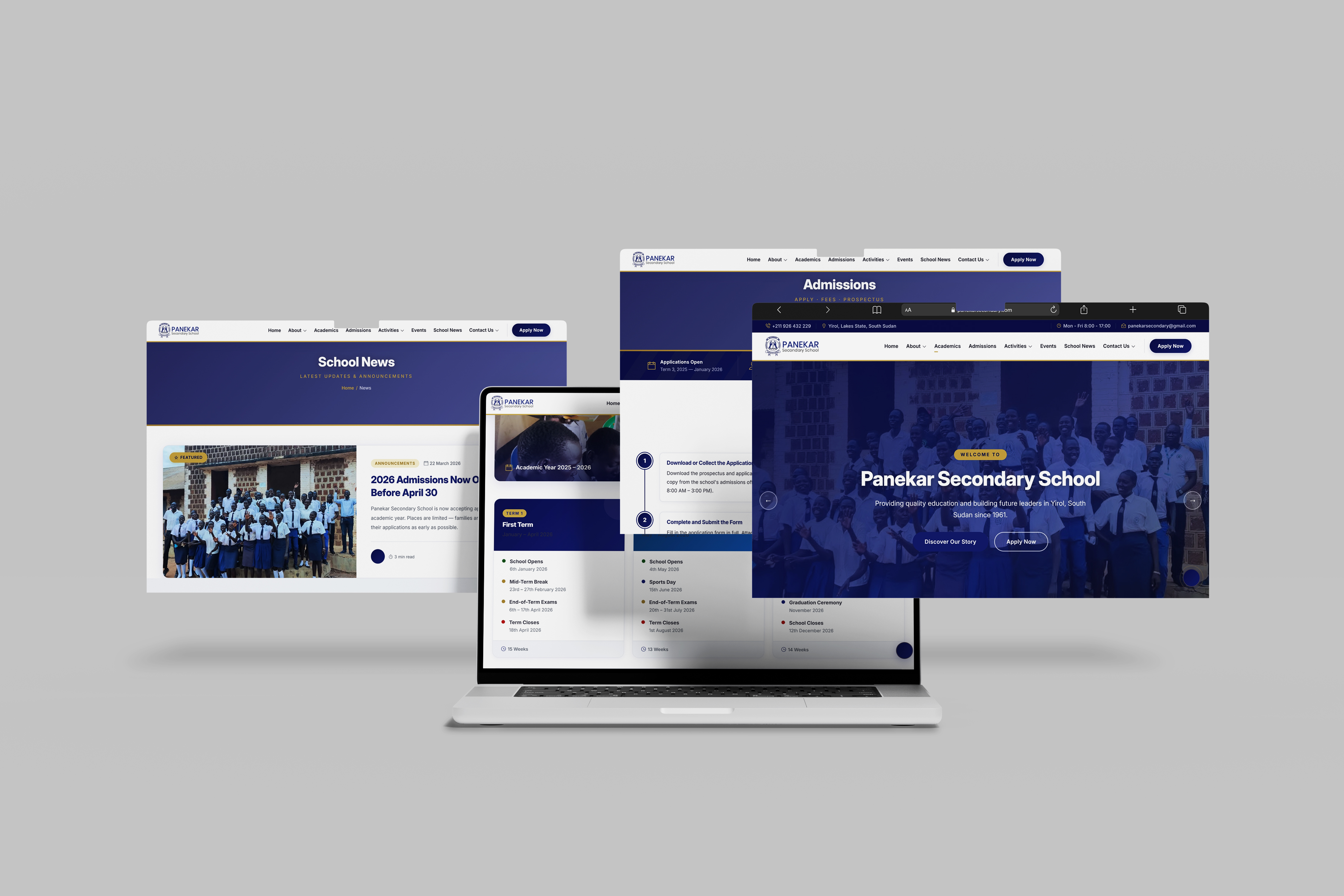
DusiCode is a South Sudan-based custom software development company specializing in solutions for schools, NGOs, banks, and businesses across East Africa. With 4+ years of experience and 100+ successful projects, we build technology that understands Africa.
Share this article
Custom Software Development
DusiCode builds enterprise-grade software systems for South Sudan businesses — from schools to banks.
Get a Free Quote Browse Solutions